Solar Panel Cleaning Drone ROI / Payback Period: How to Model It Before You Buy
2026-11-17
Solar Panel Cleaning Drone ROI / Payback Period: How to Model It Before You Buy
Solar array owners rarely buy a cleaning drone because the technology is interesting; they buy because soiling costs money every month. The decision reduces to a financial question: what solar panel cleaning drone ROI can we defend to an investment committee, and how many months until the capital is recovered? This article sets out a transparent model, the lines that belong in it, and the assumptions that distort payback period estimates.
– solar panel cleaning drone payback period calculation
What Payback Period Actually Measures
Payback period is the time needed for accumulated net benefits to equal the initial outlay. It is a cash metric, not total profitability, so report it alongside a multi-year return figure. A solar panel cleaning drone ROI analysis that stops there hides the aircraft’s residual value and the maintenance tail. Present both, state the review horizon, and give the investment committee the full picture.
The Cost Side of the Equation
Capital cost in any solar panel cleaning drone ROI model covers the aircraft, tether or battery set, spray system, transport cases, pumps and water tanks. Operating cost covers crew time, water and filtration, site transport, spares, insurance and recalibration. Training belongs here too, since unskilled operation erodes solar panel cleaning drone ROI through damage and downtime. Buyers counting only the purchase price overstate the return, and the error surfaces within one quarter.
The Benefit Side: Yield Recovery
Soiling reduces irradiance reaching the cells, and the loss accumulates between cleanings, which is why solar panel cleaning drone ROI depends on interval. Published field studies commonly report losses in the low single digits per month in temperate conditions and considerably more in dusty regions, so recoverable energy depends on site climate. A credible solar panel cleaning drone ROI model uses the site’s own performance ratio and cleaning log, not a generic percentage. Where no data exists, measure for one interval before buying a fleet.
The Benefit Side: Labour and Water Displacement
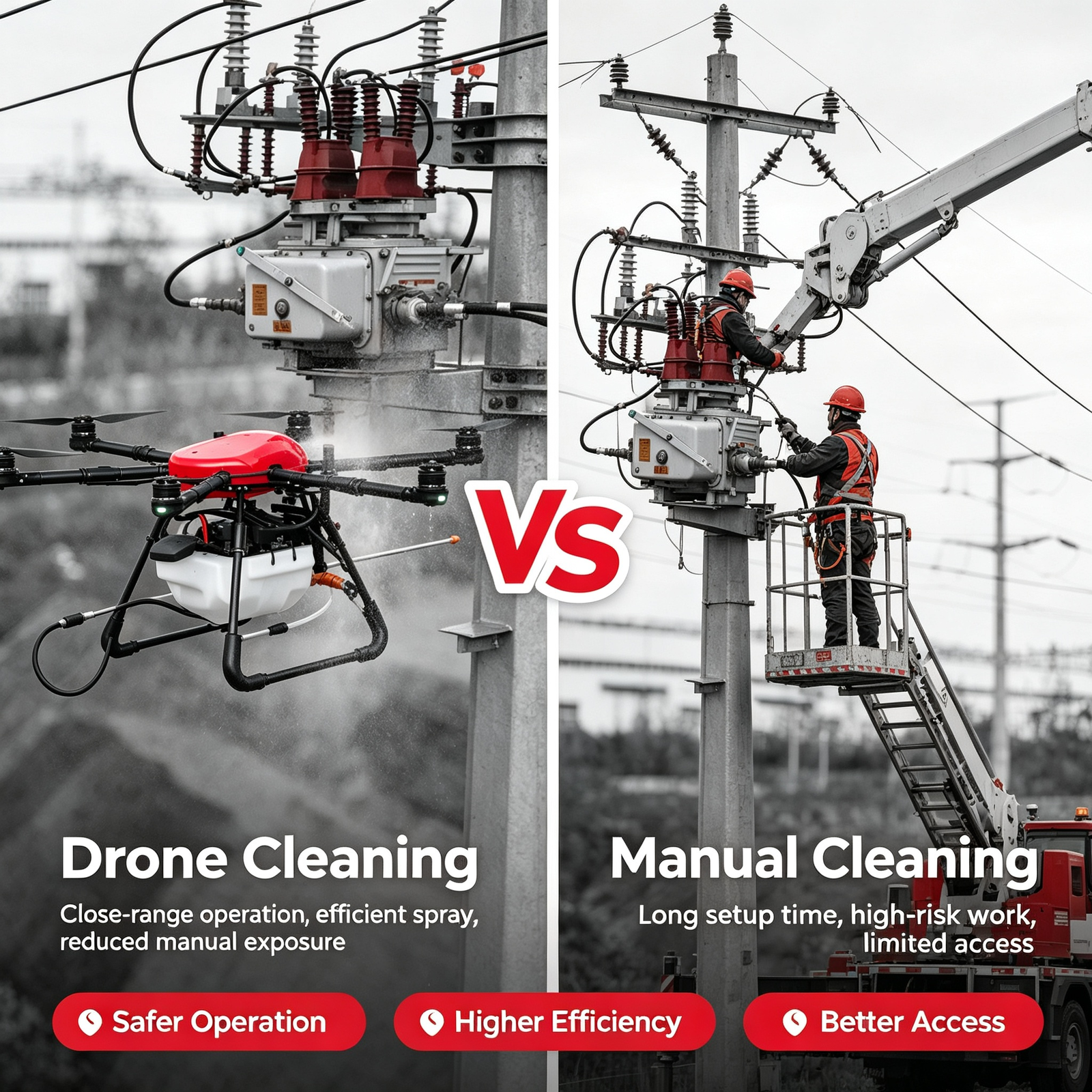
The second benefit line in any solar panel cleaning drone ROI case is avoided manual cost. Manual cleaning of a large array consumes crews, access equipment and water, often at night to avoid production losses. A drone programme changes that arithmetic: fewer hours per megawatt, less water through targeted nozzles, and daytime access on low-yield days. Solar panel cleaning drone ROI improves fastest where labour is expensive, sites are remote, or arrays are mounted where manual access is slow and risky.
The Benefit Side: Frequency and Flexibility
Fixed cleaning schedules waste effort on clean arrays and neglect dirty ones alike. Drone programmes can be scheduled against soiling data, dust events and seasonal patterns, which lifts solar panel cleaning drone ROI per visit. That flexibility is a benefit line buyers often forget. When you build solar panel cleaning drone ROI assumptions, include redeploying the aircraft across multiple sites, because portfolio utilisation is what decides whether one unit pays for itself.
A Worked Model You Can Adapt
The arithmetic is simple: the payback period in months equals net capital outlay divided by monthly net benefit, while annual return in percent equals yearly net benefit divided by capital outlay. Take an illustrative case: a mid-sized commercial array in a moderately dusty region, a price covering aircraft plus tethered supply, and a monthly benefit combining recovered yield with avoided manual cleaning. Substitute your own quotations, tariffs and soiling data, and keep every solar panel cleaning drone ROI claim tied to its assumptions.
Assumptions That Distort the Result
Four assumptions distort most solar panel cleaning drone ROI projections. First, soiling rates borrowed from another continent. Second, utilisation set at an optimistic level that ignores weather downtime and travel. Third, maintenance and spares omitted from annual cost. Fourth, energy priced at an average tariff when recovered output actually displaces expensive peak purchases. Stress-test each one before signing, because a model that survives a pessimistic utilisation case beats an elegant spreadsheet built on best-case inputs.
What Accelerates Payback
Certain conditions shorten the solar panel cleaning drone ROI break-even quickly: heavy soiling, expensive manual access, tall or complex mounting, scarce water, and a portfolio large enough to keep the aircraft busy. Tethered power helps as well, because continuous supply removes battery swap time and extends the working window. Where several of these conditions combine, the payback period tends to move from marginal to compelling within a single season.
What Stretches Payback
An honest solar panel cleaning drone ROI model also names the drags. Wind limits interrupt scheduled work and erode solar panel cleaning drone ROI, aviation rules cap altitude and proximity, water logistics add transport cost on remote sites, and unpaved access slows repositioning. New operators climb a learning curve, so early productivity runs below the mature figure. Buyers who plan for these keep expectations intact; those who assume perfect conditions defend a missed number.
How to Verify a Supplier’s ROI Claim
Ask any vendor to expose the model behind their solar panel cleaning drone ROI figure. Request the soiling assumption, cleaning frequency, labour rate, maintenance reserve and utilisation level, then a demonstration and a similar-climate reference project. A supplier answering with an auditable spreadsheet is credible; one quoting a headline percentage is selling optimism. Solar panel cleaning drone ROI is an engineering-financial calculation, and it should be reproducible by your own analyst.
Where Hoch Fits
Shandong Hoch Technology Innovation Co., Ltd. builds cleaning platforms in Weifang with six-axis redundant flight control, adjustable pressure and matched nozzles for coated panels, plus tethered supply for continuous work across large arrays. The company holds CE-RED, FCC and RoHS certification, runs a digital QC line, supports OEM and ODM branding, and provides free flight simulation software, 24/7 technical support and deployments in more than fifteen countries. For buyers building a solar panel cleaning drone ROI case, Hoch supplies specification data, test records and configuration advice rather than promises alone.
Conclusion
A defensible solar panel cleaning drone ROI comes from four inputs: capital cost, real soiling loss, avoided manual cost and realistic utilisation. Model them openly, stress the pessimistic case, and verify supplier claims against your own site data. Hoch supports that process with certified hardware, continuous tethered operation and global service. Send us your array size, tariff and cleaning history, and our team will help build a payback estimate you can take to the investment committee.
FAQ
What solar panel cleaning drone ROI result is realistic?
It depends on soiling rate, labour cost and utilisation, which together set the solar panel cleaning drone ROI. With heavy soiling and costly manual access, the payback period often falls within a few seasons; low-dust sites take longer.
Should I count recovered yield at the full tariff?
Only output actually sold or consumed at that time; where generation is curtailed, a solar panel cleaning drone ROI that counts full-tariff yield overstates the benefit.
Does one drone serve one site?
Usually a portfolio: utilisation across several arrays is the strongest solar panel cleaning drone ROI driver, and a single-site deployment rarely justifies the capital.
How do I test the assumptions before buying?
Measure soiling loss for one cleaning interval, log manual cost per visit, then request a demonstration and rebuild the model with measured inputs.