How Much Faster Is Drone Facade Cleaning Than Manual Work? 2026 Speed Comparison
2026-08-17
How Much Faster Is Drone Facade Cleaning Than Manual Work? 2026 Speed Comparison
For commercial cleaning contractors and property managers handling high-rise building maintenance, construction speed and project cycle stability directly determine business profitability and client satisfaction. Traditional manual facade cleaning relying on rope access, scaffolding and aerial work platforms is notoriously slow, labor-intensive and easily delayed by external factors. This leads to one of the most searched practical questions in the building maintenance industry: how much faster is drone facade cleaning than manual work. Based on standardized industrial test data and real on-site project cases, the intuitive answer to how much faster is drone facade cleaning than manual work is 5–10 times faster in conventional scenarios, and up to 20 times faster on large-scale complex building projects. Fully understanding why and how much faster is drone facade cleaning than manual work helps maintenance teams optimize project scheduling, shorten delivery cycles and expand annual service capacity significantly.
Many building owners still underestimate the efficiency gap between drone cleaning and traditional manual work, simply judging working speed by surface cleaning area alone. In fact, when calculating how much faster is drone facade cleaning than manual work, we need to include hidden time costs such as site setup, equipment dismantling, weather suspension and rework correction. Industrial drone facade cleaning eliminates most time-wasting links in manual operations, creating an overwhelming speed advantage. Clarifying the full-cycle efficiency gap is the most authoritative way to answer how much faster is drone facade cleaning than manual work for commercial bidding and project budgeting.
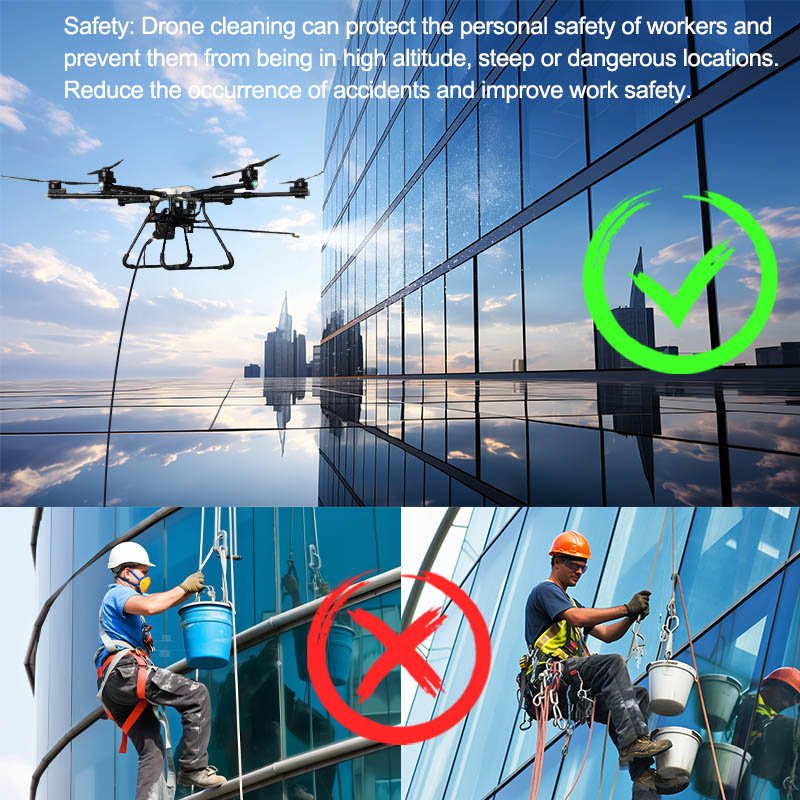
How much faster is drone facade cleaning than manual work – high-rise efficiency comparison
How Much Faster Is Drone Facade Cleaning Than Manual Work? Official Data Comparison
To objectively answer how much faster is drone facade cleaning than manual work, we adopt unified industry measurement standards, comparing hourly cleaning coverage, daily working output and full-project cycle between professional drone solutions and traditional manual cleaning crews.
Hourly cleaning efficiency gap A professional manual high-rise cleaning crew can only stably complete about 100 square meters of facade cleaning per hour, limited by physical stamina, manual operation precision and high-altitude safety restrictions. In contrast, a single industrial cleaning drone can steadily cover 500 to 800 square meters per hour with fixed-distance cruise and continuous automatic flushing. From basic hourly output, drone facade cleaning is at least 5 times more efficient, which is the most intuitive data proving how much faster is drone facade cleaning than manual work.
Daily working capacity difference Manual workers require regular rest breaks, safety checks and posture adjustments during high-altitude operations, with limited effective working hours per day. Meanwhile, professional facade cleaning drones support long-duration continuous operation, free of physical fatigue and frequent rest intervals. A manual team needs nearly one week to complete a 10,000-square-meter high-rise facade project, while a single drone can finish the same workload in just 1–2 working days. This massive daily capacity improvement further explains how much faster is drone facade cleaning than manual work for medium and large projects.
Full-cycle project speed advantage Manual facade cleaning requires pre-work preparation including scaffolding erection, safety rope layout and site enclosure, which usually takes 1–3 days of auxiliary preparation time before formal cleaning. Drone cleaning requires only simple on-site inspection and parameter calibration, taking less than one hour to start operation. When including setup, adjustment and post-work dismantling time, the comprehensive cycle efficiency of drone cleaning can reach up to 10–20 times faster than manual work on complex high-rise buildings, perfectly answering how much faster is drone facade cleaning than manual work in real engineering scenarios.
Why Drone Facade Cleaning Is Far Faster Than Manual Cleaning
The core reasons behind the speed gap that defines how much faster is drone facade cleaning than manual work lie in working mode differences and operational limitations.
No physical stamina and altitude restrictions High-altitude manual cleaning is physically demanding and risky, forcing workers to slow down and take frequent breaks to ensure safety. Drones completely break through human physical limits, maintaining stable high-speed cleaning efficiency from low floors to super high-rise facades without speed attenuation. This non-stop working state is the key reason how much faster is drone facade cleaning than manual work.
Intelligent fixed-path cleaning avoids repeated work Manual cleaning relies entirely on personal experience, easily causing missed cleaning areas, repeated flushing and uneven cleaning traces, which require extra rework time. Industrial cleaning drones follow preset precise flight routes, achieving uniform and full-coverage cleaning in one pass. Zero rework and zero omissions save a large amount of invalid working time, further amplifying the speed advantage that determines how much faster is drone facade cleaning than manual work.
Strong environmental adaptability reduces downtime Manual high-altitude work must stop completely in windy, foggy or slightly harsh weather, resulting in frequent project delays. Professional cleaning drones adapt to complex urban high-altitude wind fields and mild weather conditions, maintaining normal operation when manual work is suspended. Fewer interruptions and higher working continuity greatly shorten the overall project cycle, fully interpreting how much faster is drone facade cleaning than manual work.
Practical Benefits of Faster Drone Cleaning Speed for Businesses
Knowing clearly how much faster is drone facade cleaning than manual work can bring tangible commercial value to cleaning enterprises and property management teams.
First, it greatly improves order undertaking capacity. With 5–10 times efficiency improvement, cleaning teams can complete more projects within the same working cycle, effectively increasing annual revenue. Second, shorter construction time reduces building operation interruption, improving tenant satisfaction and client reputation. Third, efficient one-time cleaning avoids rework costs and time losses, optimizing project profit margins. Finally, faster project delivery helps enterprises gain advantages in bidding and market competition, forming a standardized and efficient intelligent service brand.
Suitable Scenarios Where Drone Cleaning Speed Shines the Most
The speed advantage answering how much faster is drone facade cleaning than manual work is most prominent in the following scenarios:
Super high-rise office buildings and urban skyscraper facade cleaning
Large-area commercial complexes, shopping malls and hotel exterior maintenance
Complex curved, special-shaped and multi-layered building facade cleaning
Large-scale industrial park factory building exterior dust removal projects
Municipal landmark buildings requiring fast construction and zero traffic disruption
Frequently Asked Questions
Q1: How much faster is drone facade cleaning than manual work in regular daily projects? In conventional mid-rise and high-rise building maintenance, drone facade cleaning is consistently 5–8 times faster than manual work. It covers more cleaning area with fewer operators and no frequent work interruptions, delivering stable and efficient results.
Q2: Does faster drone cleaning mean lower cleaning quality? No. The high efficiency of drone cleaning comes from intelligent route planning and stable pressure flushing, not rushed operation. Drone cleaning achieves 95%+ cleaning uniformity, higher than manual work, with no streaks or blind spots, balancing speed and quality perfectly.
Q3: Can drone cleaning speed advantage offset equipment investment costs? Absolutely. The efficiency improvement of 5–10 times greatly expands order volume, reduces labor input and shortens project cycles. Most cleaning teams can recover equipment costs in a short time through improved productivity, making drone cleaning a high-return upgrade solution.
Conclusion
To sum up, the definitive answer to how much faster is drone facade cleaning than manual work is 5–10 times faster in conventional projects and up to 20 times faster in large-scale complex high-rise building scenarios. The huge efficiency gap stems from drones’ non-stop continuous operation, intelligent precise cleaning and strong environmental adaptability, completely subverting the low-efficiency mode of traditional manual high-altitude cleaning. For modern commercial cleaning contractors and property management enterprises, adopting drone facade cleaning technology is the best way to improve service efficiency, shorten project cycles, reduce operational costs and enhance core market competitiveness.