How Does a Tethered Cleaning Drone Work? Complete Working Guide 2026
2026-08-19
How Does a Tethered Cleaning Drone Work? Complete Working Guide 2026
Industrial building and solar panel cleaning continues to shift from risky manual high-altitude operation to intelligent automated solutions. Among all aerial cleaning equipment, tethered cleaning drones stand out with unlimited flight time, stable operation and continuous high-pressure cleaning capabilities, becoming the preferred device for long-hour large-scale maintenance projects. Many cleaning contractors and property technicians new to this intelligent equipment often ask: How does a tethered cleaning drone work. Unlike conventional battery-powered cleaning drones limited by short battery life, the working logic of a tethered model is completely different, relying on ground-linked integrated systems to achieve uninterrupted aerial cleaning. To fully understand its industrial advantages and application value, we will thoroughly explain how does a tethered cleaning drone work from core structure, working principles and on-site operation procedures.
Most users confuse tethered cleaning drones with ordinary commercial cleaning UAVs, failing to recognize their systematic working mechanism. The question of how does a tethered cleaning drone work cannot be answered simply by flight and spraying functions. It is a complete industrial working system composed of power supply, water delivery, flight control and pressure washing modules. Mastering how does a tethered cleaning drone work helps equipment operators standardize construction processes, avoid operational errors, and maximize cleaning efficiency and safety in high-rise facade and solar farm maintenance projects.
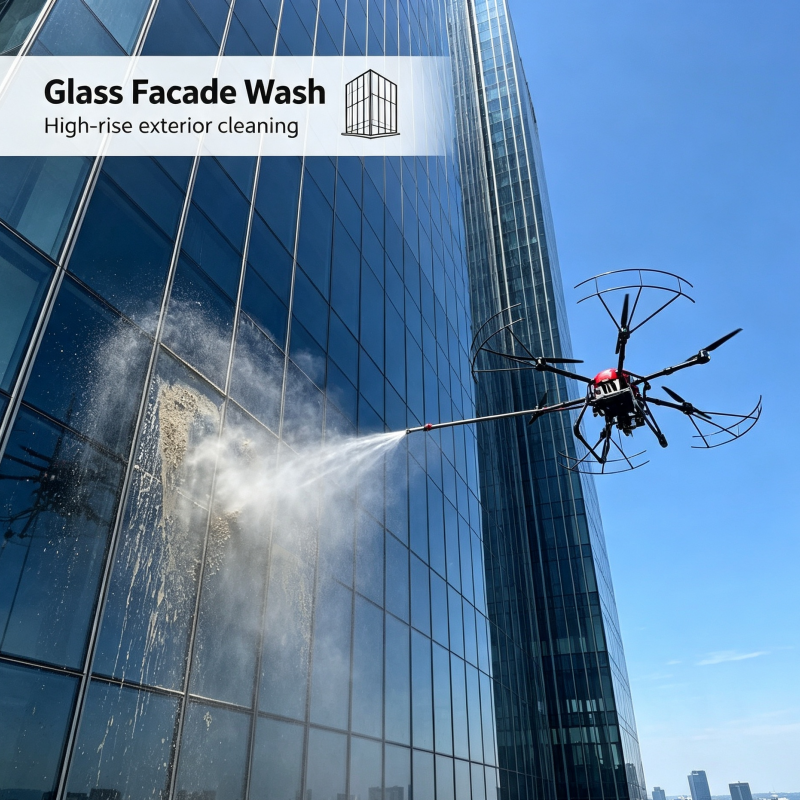
Industrial tethered cleaning drone continuous power and water supply working mode
How Does a Tethered Cleaning Drone Work? Core System Composition
To accurately answer how does a tethered cleaning drone work, we first break down its four core linked systems, which together support long-term, stable and continuous cleaning operations.
Tethered power supply system (core endurance module) The biggest difference between tethered cleaning drones and battery drones lies in the power supply mode, which is also the foundation of how does a tethered cleaning drone work. The drone is connected to a ground portable power station through a dedicated lightweight tether cable, realizing real-time continuous power transmission. This design completely abandons battery capacity limitations, allowing the drone to achieve 24-hour non-stop cyclic flight without frequent landing for battery replacement or charging. Stable wired power supply also avoids voltage instability of battery power, ensuring consistent flight power during high-pressure cleaning operations.
Integrated water delivery and pressure washing system Another key part of how does a tethered cleaning drone work is the ground-to-air water supply structure. The matched high-pressure water pump and water tank are placed on the ground, and clean water or diluted environmentally friendly cleaning agents are transported to the aerial nozzle through the internal pipeline of the tether cable. The industrial-grade pressure regulation module supports stepless pressure adjustment, freely switching low-pressure dust cleaning and high-pressure stain removal. The integrated water supply system ensures stable water flow and pressure without interruption during long-hour operation, solving the water shortage problem of traditional cleaning drones.
Intelligent stable flight control system To adapt to long-term high-altitude operation, the tethered cleaning drone is equipped with a professional attitude correction and anti-turbulence flight system. This auxiliary system guarantees how does a tethered cleaning drone work stably in complex urban wind environments. The drone automatically senses high-altitude wind speed and facade distance, dynamically adjusting flight angle and hovering position to maintain a fixed cleaning distance from the building surface. Even with long-distance tether traction, it will not jitter or deviate, ensuring uniform and consistent cleaning effects.
Ground integrated control terminal The entire working process of the equipment is uniformly scheduled by the ground control terminal, which is the command center of how does a tethered cleaning drone work. Operators monitor real-time flight status, water pressure parameters and cleaning coverage through the terminal, and can adjust flight routes and cleaning intensity at any time according to on-site pollution conditions. The one-key emergency stop and fault alarm functions ensure safe and controllable operation throughout the whole process.
Complete Working Process: How Does a Tethered Cleaning Drone Work On-Site
The standardized operation process intuitively reflects how does a tethered cleaning drone work in actual engineering scenarios, divided into four simple and efficient steps.
Step 1: On-site layout and equipment connection Place the ground power supply, water tank and high-pressure pump in a flat and safe area, connect the tether cable and water pipeline, and complete power-on self-inspection of the whole system. The equipment automatically calibrates flight parameters and pressure values to prepare for aerial operation.
Step 2: Fixed-height takeoff and positioning After parameter confirmation, the drone takes off automatically and hovers stably at a safe distance from the building facade or solar panel array. The intelligent system locks the cleaning height to avoid collision with walls or equipment, laying a foundation for efficient cleaning.
Step 3: Continuous cyclic cleaning operation Start the high-pressure water supply system, and the drone flies along the preset route for full-coverage flushing. Relying on tethered continuous power and water supply, it performs uninterrupted cyclic cleaning, covering large-area facades and PV arrays without repeated takeoff and landing.
Step 4: Completion inspection and equipment recovery After the cleaning operation covers the whole area, the operator checks the cleaning effect through the ground terminal, closes the water supply and power system in turn, and controls the drone to land safely for equipment sorting and maintenance.
Unique Working Advantages of Tethered Cleaning Drones
After clarifying how does a tethered cleaning drone work, we can clearly understand its irreplaceable industrial advantages compared with battery cleaning drones.
First, unlimited endurance. Breaking through battery restrictions, it supports all-day continuous cleaning, which is very suitable for large-scale solar farms and super high-rise building long-hour maintenance. Second, more stable cleaning quality. Wired power supply and ground water pump ensure stable water pressure and flight status, avoiding uneven cleaning caused by battery power attenuation. Third, higher operational safety. The tethered structure provides physical safety protection, effectively preventing drone crash and loss, and the ground centralized control reduces high-altitude operational risks. Fourth, lower long-term loss. No frequent battery replacement is required, greatly reducing later equipment maintenance costs.
Main Application Scenarios
Based on the working mechanism of how does a tethered cleaning drone work, it performs best in the following commercial scenarios:
Large-area ground solar farm continuous panel cleaning
Super high-rise office and commercial building facade maintenance
Long-distance curved building and complex structural cleaning
Municipal landmark buildings requiring long-hour fine cleaning
Industrial park high-rise factory building exterior dust removal projects
FAQs
Q1: How does a tethered cleaning drone work differently from battery drones? The core difference lies in power and water supply. A tethered cleaning drone relies on ground tethered continuous power supply and water delivery, achieving unlimited endurance and stable pressure output, while battery drones are limited by battery life and require frequent landing replacement, unable to support long-hour continuous work.
Q2: Will the tether cable affect the flexible operation of the drone? No. Professional lightweight and tensile tether cables are adopted, which are matched with intelligent line retraction systems. The cable will not drag or restrict flight flexibility, ensuring the drone can freely adapt to complex facade cleaning angles.
Q3: Is the working mode of a tethered cleaning drone suitable for small projects? It is more suitable for medium and large-scale long-cycle cleaning projects. Its unlimited endurance and high-efficiency continuous operation advantages can be maximized in large-area maintenance scenarios, bringing higher return on investment.
Conclusion
In summary, the core answer to how does a tethered cleaning drone work is a systematic working mode composed of tethered continuous power supply, ground water pressure delivery, intelligent stable flight and ground integrated control. Different from traditional battery cleaning drones, this industrial working mechanism completely solves the pain points of short endurance, unstable power and discontinuous cleaning. For modern large-scale photovoltaic maintenance and high-rise building facade cleaning projects, tethered cleaning drones have become an indispensable intelligent equipment, helping cleaning enterprises achieve safer, more efficient and lower-cost standardized maintenance operations.