High Pressure Cleaning Drone for Solar Panels: Recover Lost Power Output in 2026
If you own or manage solar farms, commercial rooftop PV systems, or industrial solar arrays, you already know one brutal truth: dirty solar panels equal lost money.
Solar panels are built to capture maximum sunlight, but daily dust, industrial particulate, pollen, bird droppings, and seasonal grime continuously cover the glass surface. This invisible layer of soiling gradually blocks solar irradiance, dragging down power generation efficiency month by month. Many solar asset managers are shocked to find that uncleaned panels can lose 10%–25% power output without anyone noticing.
For decades, solar cleaning relied on manual walking, water trucks, and handheld washing tools. But traditional cleaning methods come with huge hidden risks, inconsistent results, and extremely high long-term operation costs. Today, the high pressure cleaning drone for solar panels is rewriting the rules of solar O&M — and our on-site video shows exactly how it restores peak solar performance safely and efficiently.
Why Traditional Solar Panel Cleaning Is Hurting Your Solar ROI
Most solar project owners underestimate how much poor cleaning affects their annual revenue. Traditional manual solar cleaning has four unavoidable drawbacks that slowly erode your solar asset value.
1. Dangerous rooftop & solar array walking risks Solar panels are installed on sloped rooftops, elevated brackets, and large-scale open solar farms. Walking directly on PV panels is extremely slippery and risky. Industry safety data shows height falls and slip accidents are the most common safety incidents in solar maintenance. Manual cleaning exposes workers to continuous high-altitude hazards and brings heavy liability pressure for solar companies.
2. Easy panel micro-cracks and coating damage Manual stepping, rough wiping, and uneven water pressure often cause invisible micro-cracks on solar cells and scratch the anti-reflection glass coating. These tiny damages do not show up immediately but gradually reduce power efficiency and shorten the overall lifespan of solar panels.
3. Low efficiency and missed cleaning cycles Large solar farms require weeks of manual cleaning work, while rooftop solar arrays are hard to reach comprehensively. Due to high labor costs and slow progress, many projects delay regular cleaning, resulting in long-term dust accumulation and continuous power loss.
4. Uneven cleaning leading to inconsistent power output Manual cleaning leaves streaks, residual dust, and blind spots. Partially clean panels cause mismatched current output, reduce overall array efficiency, and even increase equipment aging speed.
Watch the Video: High Pressure Cleaning Drone Cleaning Solar Panels On-Site
Our real-site video captures the full working process of an industrial high pressure cleaning drone operating on genuine solar panel arrays. Unlike exaggerated marketing clips, this unfiltered footage shows the actual cleaning logic and real improvement effect for solar maintenance.
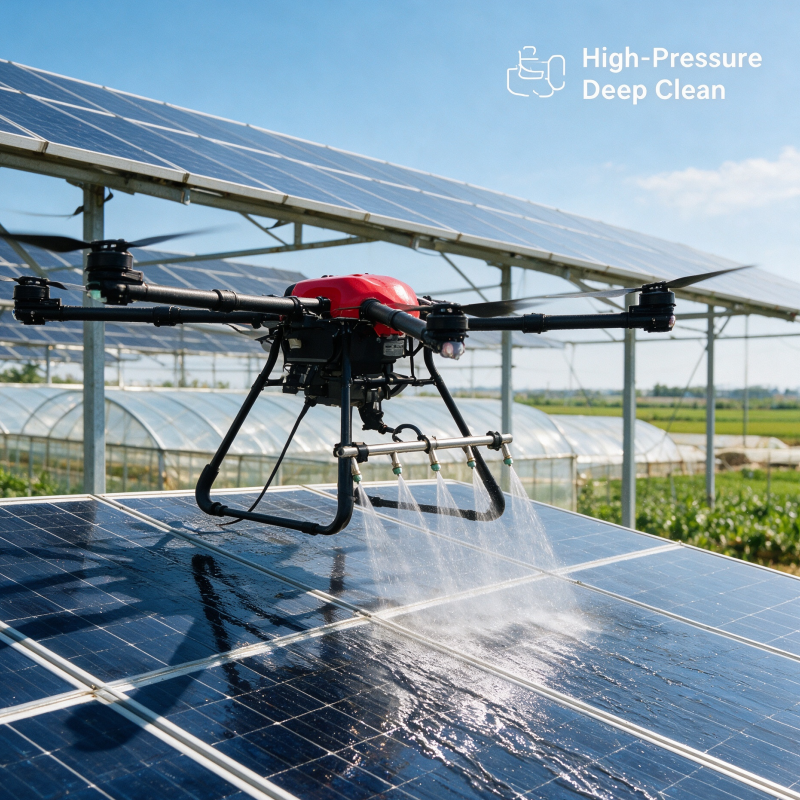
In the video, the drone stably hovers above the solar panels without any contact or stepping on the PV surface. Equipped with an intelligent adaptive high-pressure water jet system, it precisely blasts away stubborn solar soiling: thick dust layers, bird stains, pollen residue, and weathered oxidation dirt that manual work cannot completely remove.
The most critical advantage visible in the video is its material protection mechanism. The drone automatically adjusts water pressure according to the solar glass hardness and dirt thickness. It uses high-pressure concentrated flow for heavy dirt areas and soft protective pressure for delicate anti-reflection coating surfaces. This achieves deep cleaning without scratching, cracking, or damaging solar panels.
Guided by intelligent path planning, the drone covers every single panel edge, gap, and corner. The final result is perfectly uniform, spotless solar glass — restoring maximum light transmittance and allowing the solar system to regain its designed power generation capacity.
Core Benefits of High Pressure Cleaning Drone for Solar Maintenance
1. Zero Rooftop Walking, 100% Safe Solar O&M
The high pressure solar cleaning drone completely eliminates human high-altitude and array walking operations. All cleaning work is remotely controlled on the ground, removing fall risks, safety accidents, and insurance liabilities. It perfectly meets modern solar project safety compliance standards, especially for rooftop solar, carport solar, and large elevated solar bracket systems.
2. Recover Lost Power Generation & Maximize ROI
Regular drone high-pressure deep cleaning removes all light-blocking pollutants, restoring solar panel light transmittance up to 98%. Field tests prove that standardized drone cleaning can stably recover 10%–20% lost power output, bringing considerable extra revenue for solar farms and commercial PV systems throughout the year.
3. Zero Micro-Crack & Zero Coating Damage
Different from manual random pressure and trampling damage, the drone’s fixed-distance non-contact cleaning mode protects solar panel glass, anti-reflection coatings, and photovoltaic cells comprehensively. It avoids hidden equipment faults caused by improper cleaning and effectively extends the service life of solar arrays.
4. 5–8 Times Higher Efficiency & Lower Long-Term Costs
Manual cleaning of a large solar farm takes weeks, while a high pressure cleaning drone can finish the same area in just a few days. It greatly shortens maintenance cycles, supports frequent regular cleaning, and cuts massive labor costs, equipment rental fees, and post-damage repair expenses. For long-term solar asset operation, drone cleaning is the most cost-effective maintenance upgrade.
5. Water-Saving & Environmentally Friendly Cleaning
Precision high-pressure atomized water flow reduces water waste compared with traditional flood washing. It achieves efficient cleaning with less water consumption, matching the green and low-carbon attributes of solar energy projects.
Best Application Scenarios
This professional solar cleaning solution fits all photovoltaic maintenance scenarios:
-
Large-scale ground solar farm cleaning
-
Commercial industrial rooftop solar panel maintenance
-
Solar carport and elevated bracket PV cleaning
-
Distributed household and factory solar arrays
-
Seasonal deep soiling removal for all PV systems
FAQ About Solar Panel High-Pressure Cleaning Drone
Q1: Will high-pressure cleaning damage solar panels? A: No. Professional industrial drones use adaptive intelligent pressure adjustment. It cleans dirt thoroughly while protecting solar glass and anti-reflection coatings, causing zero damage to PV panels.
Q2: How much power can drone cleaning recover? A: Depending on soiling levels, regular drone cleaning can recover 10%–20% of lost power output, greatly improving solar project ROI.
Q3: Is drone cleaning cheaper than manual solar cleaning? A: Yes. It drastically reduces labor, safety, and repair costs, with far higher efficiency and cleaner results, bringing superior long-term economic benefits.
Q4: How often should solar panels be cleaned? A: For best power output, seasonal cleaning 3–4 times a year is recommended. Drone cleaning makes frequent maintenance easy and affordable.
Final Verdict
Solar asset profit largely depends on stable power generation and low maintenance loss. Traditional manual cleaning can no longer meet the high-standard safety, efficiency, and precision requirements of modern solar O&M.
A high pressure cleaning drone for solar panels is not just a cleaning tool — it is a revenue-enhancing device for solar projects. It eliminates safety risks, avoids equipment damage, improves power output, and reduces operational costs, becoming the new standard for global solar photovoltaic maintenance in 2026.
Discussion (Comment Below)
Have you noticed obvious power drop caused by dirty solar panels? How much do you think regular drone cleaning can improve your solar project revenue? Leave your comment and share your solar maintenance experience!